
If it’s been months since your furnace last kicked on, that first startup deserves a quick once-over before you trust it to run all night. This guide walks you through the checks worth doing before the season’s first heat in Huntington Beach and coastal Orange County — how to test your carbon monoxide detector, and which smells and sounds are just your system waking up versus a real red flag. Brightwater Heating & Air put this together for you. We’re a licensed California HVAC contractor, CSLB #1004454.
The whole check takes about 15 minutes. You do not need tools or technical skill. Keep the access panels closed, leave the gas components alone, and stick to what you can see, hear, and smell from outside the cabinet.
Do this before the first cold night, not on it
Test your heat in late September or early October, on a warm afternoon, well before you actually need it. A problem you find on a mild day is an inconvenience. The same problem at 10 p.m. on the first cold night is an emergency.
Timing also changes how fast you get help. In early fall, Brightwater can usually reach your home the same week, at a normal appointment time. Once Orange County gets its first real cold snap, every heating company in the county fields calls at once and the wait stretches for everyone.
So pick a mild day. Set aside 15 minutes. Work through the physical checks below first, then run the system while you are standing there paying attention.
For the rest of the year, our year-round maintenance calendar for coastal and inland homes covers the other seasons. This guide stays with the first burn.
The five-minute check before you turn it on
Do these five things before you set the thermostat to HEAT. None of them requires opening the equipment.
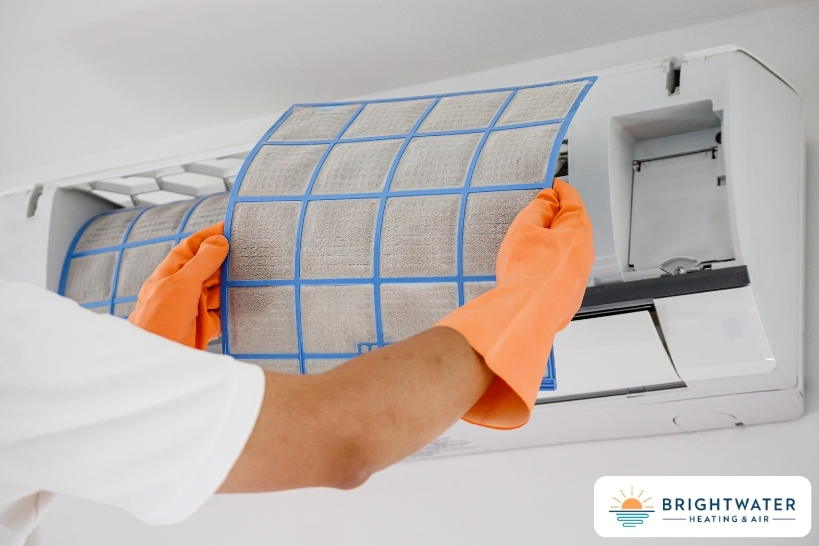
1. Replace the air filter. Pull it out and look at it. If it is grey and matted, or past the date printed on the frame, swap it. Match the size, and point the airflow arrow toward the furnace. A clogged filter chokes airflow, and restricted airflow makes a furnace overheat and shut itself down on its first run. If you are not sure which one fits, our air filtration page walks through the options.
2. Clear whatever you stacked against the equipment. Beach chairs, storage bins, laundry baskets, and paint cans drift toward the furnace or air handler over the summer. Give the unit open space on every side. Combustion equipment needs air to draw, and hot surfaces need distance from anything that burns.
3. Open and unblock the vents. Walk the house. Confirm every supply register and return grille is open and not covered by a rug, a couch, or a closed damper. Blocked vents starve the blower and throw the airflow balance off room to room.
4. Check the thermostat batteries and mode. Put fresh batteries in if it takes them. Switch the mode from COOL or OFF to HEAT, and set the target a few degrees above the current room temperature. That gives the system one clean, definite call for heat instead of a borderline one.
5. Confirm the power switch is on. The furnace or air handler has a switch that looks like a light switch, usually on or beside the cabinet, plus a breaker in the panel. Both need to be on. Use only that switch and that breaker. Do not remove access panels or reach inside the cabinet.
Airflow clear, controls set, power on. Now you can run it.
Test your carbon monoxide detector first
Test every carbon monoxide alarm in the house before you light the furnace, not after. This matters most in a home with a gas furnace, a gas water heater, a fireplace, or an attached garage.
Press and hold the test button until the alarm sounds loud and clear. A weak chirp or silence means the batteries are dead. Change them and test again.
Check the placement. The CDC recommends a carbon monoxide detector near every sleeping area. The Consumer Product Safety Commission recommends one on every level of the home and outside sleeping areas. A smoke alarm is not a CO alarm unless the label says it is a combination unit.
Check the date on the back. This is the step almost nobody does. CO sensors wear out, and the housing carries a manufacture date or an end-of-life marking. The CDC says to replace a CO detector following the manufacturer’s instructions, or every five years.
California Health and Safety Code Section 17926 requires an approved carbon monoxide device in dwellings with a fossil fuel burning heater or appliance, a fireplace, or an attached garage.
Do not start the heat test until you have a working, in-date CO alarm.
The 15-minute test run: what is normal and what is not
Set the thermostat a few degrees above room temperature and stay in the house for 15 minutes. A dusty, singed, faintly burnt smell in the first 10 to 15 minutes is normal. Dust, lint, and pet hair settle on the heat exchanger or the electric heat strips over a summer of sitting still, and that layer burns off the first time the metal gets hot. Crack a window if the smell bothers you. It should fade, and it should not come back on the next cycle.
Here is how to sort what you are hearing and smelling.
| Normal on the first run | Stop the system and call |
|---|---|
| A burnt dust smell that fades within 10 to 15 minutes | A burning smell that lasts past the first run or returns on later cycles |
| Soft ticking as sheet metal warms and expands | Scraping, grinding, or rattling from the blower or motor |
| Warm air at the registers within a few minutes | Repeated clicking with no ignition, or no heat at all |
| One full heating cycle that finishes without tripping a breaker | Short cycling, where the system starts and stops every few minutes |
| A steady blue burner flame through the sight glass | A yellow or lazy flame, or soot around the burner window |
A rotten egg or sulphur smell is a different situation entirely. Leave the building right away. Do not flip light switches, unplug anything, or use a garage door opener, because a spark is the risk. Once you are outside and away from the house, call SoCalGas at 1-800-427-2200 from a safe location, and call 911 if anyone is in immediate danger.
“A lot of what we see on the first cold night is not a broken furnace. It is a system that sat still all summer and never got looked at before somebody needed it. Running it once in September tells you almost everything.” Sean Pierik, owner of Brightwater Heating & Air.
If the system will not light at all, that is a diagnostic job rather than a homeowner one. Do not keep resetting the breaker or cycling the thermostat, because repeated failed attempts can lock out the control board. Book furnace repair and let a technician read the fault code off the board.
What eight idle months do to a coastal heating system
A furnace in a cold climate runs most of the winter. A furnace in Huntington Beach might run a few dozen hours all year, then sit untouched from March to November. Sitting still is harder on heating equipment than running.
Along the coast, in Huntington Beach, Newport Beach, Seal Beach, Laguna Beach, Costa Mesa, and Dana Point, four things happen during those idle months.
| What Happens During Idle Months | How It Affects the Heating System |
|---|---|
| Dust settles on the burners and the heat exchanger | That is the burning smell on startup, and a heavy layer can also delay ignition. |
| Salt air and marine layer humidity corrode the flame sensor and the cabinet | An oxidized flame sensor tells the control board there is no flame, the board shuts the gas off, and you get a system that lights and quits a few seconds later. |
| Inducer motors and blower bearings seize | A motor that spun fine in March can bind after eight months of never turning. |
| Spiders, nesting debris, and leaves block flue and vent openings | A restricted flue trips the pressure switch and stops the sequence before the burners ever light. |
Humidity is the piece most homeowners underestimate. We go deeper on it in our guide to HVAC tune-ups in Huntington Beach’s marine layer.
So “it worked fine in March” describes March. It does not tell you whether the flame sensor is clean today, whether the inducer will spin, or whether the flue is clear. The only way to find out is to run the system and watch it.
What a technician checks that you cannot
Your 15-minute test tells you whether the system starts and whether anything smells or sounds wrong. It cannot tell you whether combustion is safe. That part takes instruments.
On a heating visit, a technician inspects the heat exchanger for cracks, since that is the component separating combustion gases from the air you breathe. A combustion analysis measures what is actually leaving the flue. Gas pressure gets checked at the valve and set to the manufacturer’s spec.
The safety controls get tested rather than eyeballed. The flame sensor, the limit switch, and the pressure switch each have to prove they still shut the system down when they should. Electrical connections get read under load, where a loose or corroded terminal shows up as heat and voltage drop that no visual check would catch.
A heat pump needs a different list: heating-mode performance, refrigerant charge, defrost operation, and the outdoor unit. Our heat pump service covers that work.
Two ways to get it handled: book a one-time visit through our heating services, or put it on a schedule with our Maintenance Membership.
Frequently asked questions
Why does my heater smell like burning dust when I first turn it on?
Dust, lint, and pet hair settle on the heat exchanger or the electric heat strips while the system sits idle all summer. The first time that metal gets hot, the layer burns off and you smell it. On a first run, that is normal. Sharp electrical smells, melting plastic, visible smoke, or a rotten egg gas smell are never normal, so shut the system down.
How long should that smell last?
Ten to 15 minutes, or through the first one or two heating cycles. A system that sat in a dusty space can take a little longer to clear. If the smell is still there after the first run, gets stronger instead of weaker, or returns on later cycles, turn the heat off and schedule service. That pattern points to a real fault, not leftover dust.
When should I schedule a heating tune-up in Orange County?
Late September or early October, before the first cold snap fills every schedule in the county. Test the system yourself first, then book. Early fall availability is far better than the week after temperatures drop, and a problem found early becomes a normal appointment instead of an after-hours call. Brightwater serves Huntington Beach and coastal Orange County.
How often should a carbon monoxide detector be replaced?
Check the manufacture date or end-of-life marking printed on the back of the unit and follow it. The CDC advises replacing a carbon monoxide detector according to the manufacturer’s instructions, or every five years. The test button only confirms that the battery and the sounder work. It does not test the gas sensor, and it does not tell you how old the unit is.
My heater did not turn on at all. What now?
Confirm the thermostat is on HEAT, set above room temperature, with fresh batteries. Then check the service switch, the breaker, and the filter. Reset a tripped breaker once. If it trips again, leave it off. Stop and call if you smell gas or nothing responds at all. Our furnace repair team can read the fault code and tell you what failed.
Book your heating check before the first cold night
Fall in Orange County gives you a short, comfortable window to find heating problems on your own terms. The first heat of the season goes a lot better when you plan it than when the weather picks the date for you.
Brightwater Heating & Air serves Huntington Beach and coastal Orange County. Book a heating check through our heating services, or join our Maintenance Membership and have it scheduled for you ahead of each season.
Call (714) 316-3755 or reach us through our contact page. Brightwater Heating & Air is a licensed California HVAC contractor, CSLB #1004454.