
When an aging air conditioner quits on a hot afternoon, or rust starts showing on the outdoor unit, you need a clear path forward. An online average can’t give you that, because it ignores your home. AC installation cost in Huntington Beach varies widely because ductwork, electrical capacity, equipment access, and coastal exposure all change the scope of the job.
The right replacement matters beyond cool air today. A system that is poorly sized or mismatched to the home can leave rooms uneven, waste energy, and lead to repairs you didn’t need to have. Homes near the beach may also need added protection so equipment holds up to salt air and moisture.
This guide walks through the details that shape a Huntington Beach estimate: equipment selection, ductwork, permits, electrical needs, access, and salt-air protection. We don’t publish one-size-fits-all prices. A sound recommendation starts with an in-home assessment, a full system inspection, and a load calculation that shows what your home actually needs.
You’ll learn when replacement deserves a look, what a complete estimate covers, how system options compare, and how to review written quotes with confidence. First, it helps to decide whether replacement belongs in the conversation at all.
When to Request an AC Replacement Evaluation
An air conditioner doesn’t need to stop working completely before a replacement evaluation makes sense. At the same time, age alone is not a reason to replace equipment that can still be repaired reliably.
A consultation helps most when you see a pattern rather than one isolated issue. Watch for signs such as:
- Repeated repair calls, or the same problem returning after service
- Declining cooling performance, including longer run times, weak airflow, or rooms that never reach the thermostat setting
- Uneven temperatures between bedrooms, living areas, or floors
- New noises, such as rattling, grinding, buzzing, or frequent cycling
- A major component concern, such as compressor failure, refrigerant leaks, or electrical problems
- An older system with visible corrosion on the outdoor cabinet, coil, wiring connections, or mounting hardware
For coastal Huntington Beach homes, corrosion deserves closer attention than it might farther inland. Salt air and marine moisture settle on exposed metal and speed up wear on condenser cabinets, coils, and fasteners. Surface rust alone doesn’t always mean you need a new system. Corrosion that reaches a coil, an electrical connection, a structural support, or a refrigerant line can change the repair conversation, though.
An evaluation also helps after you buy a home with a working but undocumented system. Missing service records, a unit that seems undersized, or comfort problems that came with the house are all good reasons to learn the system’s condition and likely next steps.
We start with a diagnosis, not a replacement recommendation. We inspect the equipment, airflow, ducts, electrical condition, refrigerant concerns, and comfort problems throughout the home. In many cases, a targeted repair, an airflow correction, or a duct improvement is the better path. Our repair-versus-replacement guide covers that decision in more detail.
What a Complete HVAC Installation Estimate Should Include
The outdoor condenser is only one part of a complete installation. A lower quote can look appealing until you notice that home-specific work was left out of the scope. A written estimate should explain how the contractor will handle:
| Estimate Item | What It Should Cover | Why It Matters |
|---|---|---|
| Matched indoor and outdoor equipment | Indoor coil, air handler, or furnace that is compatible with the outdoor unit | A mismatched system can affect efficiency, cooling capacity, and manufacturer warranty requirements |
| Refrigerant lines and drainage | Existing refrigerant lines checked for size, condition, leaks, and compatibility, plus a condensate drain with the right slope, connections, and safety protection | Carries moisture away from the home and confirms the existing lines suit the new system |
| Electrical and safety components | An electrical disconnect and other required safety parts | Confirms the circuit can safely support the new equipment |
| Old-equipment removal | Removal and responsible disposal of the existing equipment | The estimate should state that removal is included |
Ductwork deserves the same attention as the new equipment. According to ENERGY STAR, leaks, holes, and poorly connected ducts waste conditioned air and make a house harder to keep comfortable. If airflow doesn’t match the new system, the project may need duct sealing, repairs, resized runs, replacement sections, or a fuller redesign.
Older Huntington Beach homes may also need electrical updates. The existing circuit, disconnect, or panel may not have the capacity the new AC, furnace, or heat pump requires. That work is part of installing equipment safely and to code.
Permits and inspections should come up before work begins. City permits are part of legitimate replacement planning in Huntington Beach, and California Title 24 energy-code requirements, including HERS testing, may apply to your project. Permits, testing, and documentation help verify safety, airflow, energy performance, and code compliance. They also give you useful records for a future home sale.
Access affects the scope as well. Tight attics, crawlspaces, second-story equipment, condo access rules, narrow side yards, and equipment relocation can all call for extra planning.
Ask every contractor these three questions:
- Are permits, inspections, and required testing included?
- What ductwork and electrical work is included or excluded?
- Does the scope include disposal, startup, commissioning, and a final performance check?
Once you know what the installation scope covers, you’re ready to compare equipment.
Choose an HVAC System That Fits Your Home, Not Your Old Unit
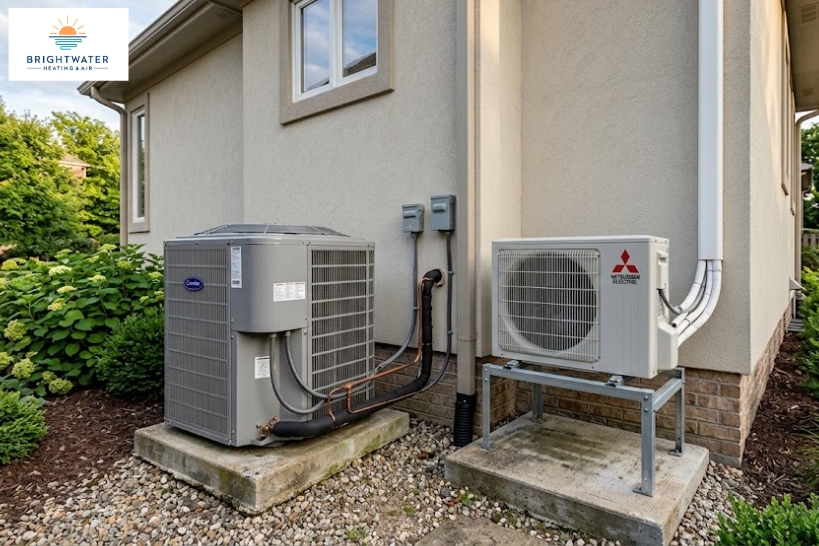
Replacing your old AC with the same capacity may feel safe, but it doesn’t prove the old system was right for your home. A system that is too large can cool the thermostat area quickly and shut off before it removes enough moisture. An undersized system may run for long stretches without keeping every room comfortable.
The right starting point is an ACCA Manual J load calculation, not a rule of thumb based only on square footage. Manual J is the residential method HVAC professionals use to estimate a home’s heating and cooling needs. It considers:
- Square footage, layout, and ceiling height
- Insulation levels and air leakage
- Window size, type, shading, and sun exposure
- Number of occupants and heat-producing appliances
- Local climate conditions
A contractor should also evaluate your existing ductwork on its own. Leaks, restricted airflow, poor insulation, or ducts that don’t match the new equipment can limit comfort even when the system itself is properly sized.
Common System Paths for Huntington Beach Homes
| System Path | Best For | Key Point |
|---|---|---|
| Central AC with existing ducts | Homes with ducts in sound condition where whole-home cooling is the goal | A duct inspection confirms the system can deliver balanced airflow to each room |
| Heat pump replacement | Homes where both sides of the HVAC system are aging or year-round efficiency is a priority | Heats and cools through one system |
| Ductless mini-splits | Older homes without ducts, additions, converted garages, and rooms with ongoing comfort problems | Each indoor unit serves a specific area, so you get room-by-room control |
If your furnace is aging along with the AC, a full HVAC system replacement may be worth pricing alongside an AC-only option. Pairing the two lets the contractor match the indoor and outdoor equipment from the start.
Single-Stage, Two-Stage, and Variable-Capacity Equipment
How the equipment runs matters, too. Single-stage systems run at one output level. Two-stage systems can run at a lower level in milder weather, which supports longer cycles and steadier temperatures. Variable-capacity systems adjust output in smaller steps, which can improve temperature consistency, humidity control, sound levels, and efficiency when they are properly designed and installed.
For a 2026 replacement, ask which refrigerant the new equipment uses. The EPA’s Technology Transitions Program limits higher-impact HFC refrigerants in new air conditioning and heat pump equipment. Many newer systems use A2L refrigerants, which need compatible equipment and specific installation and safety practices.
Coastal Details That Can Change AC Installation Cost in Huntington Beach
Two Huntington Beach homes can get the same equipment and still need different installation plans. A condenser in a sheltered side yard may face far less salt than one sitting in the ocean wind a few blocks closer to the beach.
During an in-home estimate, we review the outdoor environment along with the equipment. Salt air and marine moisture can speed up corrosion on condenser coils, cabinets, screws, brackets, and electrical connections. Depending on the home’s exposure, the plan may include factory-coated coils, corrosion-resistant hardware, protected placement, or better drainage around the pad.
Not every beach-area home needs every protective feature. Recommendations should reflect the home’s distance from the coast, direct wind exposure, nearby sprinklers, standing water, drainage, and the condition of the current system.
Placement matters for performance and future service. An outdoor unit needs enough clearance for airflow and maintenance. Screening can cut direct exposure or improve appearance, but a narrow, hot, damp side yard can trap heat around the condenser and make repairs harder. The goal is to protect the unit where practical without choking the airflow it needs.
Before you finalize an installation plan, ask about:
- HOA or architectural approval for equipment location, screening, and exterior changes
- Side-yard setbacks and property-line requirements
- Rooftop, balcony, attic, or gated-access limits
- Allowed work hours for condos and managed communities
- Noise expectations, especially in Huntington Harbour and other close-set neighborhoods
Quieter equipment and careful placement make a real difference when a condenser sits near a bedroom window, patio, shared wall, or neighbor’s home. A unit that is hard to reach also complicates routine maintenance, repairs, and the next replacement.
Before you approve equipment, ask the contractor to explain the manufacturer’s warranty conditions and any maintenance expectations for a coastal setting. Registration, installation, and ongoing care can affect coverage, depending on the brand and product.
Coastal vs. Inland HVAC Installation Cost in Orange County
If you’re comparing quotes from contractors across Orange County, keep in mind that a coastal plan and an inland plan solve different problems. The equipment list may look similar on paper while the priorities underneath it differ.
Near the coast, the main threats are salt, moisture, and corrosion. Protective coatings, hardware choices, placement, and drainage often carry more weight in Huntington Beach, Seal Beach, Sunset Beach, Newport Beach, and Costa Mesa. Humidity control also matters, which is one more reason an oversized system that short-cycles is a poor fit for a beach home.
Inland homes in cities such as Irvine, Tustin, Orange, and Santa Ana face a different load. Longer stretches of heat and higher cooling demand put more weight on accurate sizing, duct capacity, and efficiency over a long cooling season. A coastal protection package may add little value there, while airflow and capacity planning add a lot.
This is why a quote built for one part of the county doesn’t transfer neatly to another. If you recently moved from an inland home to the coast, or the other way around, expect the recommendations to change with the location. A good contractor will explain which items respond to your home’s conditions and which ones are standard for every installation.
How to Compare AC Replacement Estimates Without Choosing on Price Alone
Two proposals can look alike and still include very different work. The lowest total on paper isn’t always the lowest-risk choice if a bid leaves out permits, duct repairs, commissioning, or coastal protection. Use this checklist when you review written estimates:
| What to Compare | What to Ask or Check | What It Should Show |
|---|---|---|
| Equipment details | Does the proposal list the exact brand and model numbers, system type, capacity, efficiency ratings, and warranty terms? | The indoor and outdoor equipment identified as a matched system |
| Documented sizing | Ask for an ACCA Manual J load calculation or another clear sizing rationale | Sizing based on your home’s heat gain, insulation, windows, layout, and airflow, not just the size of the old unit |
| Permits, testing, and closeout | Confirm who coordinates permits, inspections, and any Title 24 or HERS requirements | Duct and electrical work, removal, disposal, startup testing, and the final walkthrough accounted for |
| Coastal installation planning | Ask how placement, drainage, service clearances, coated coils, and corrosion-resistant hardware are handled | A plan that fits your home’s exposure to salt air and moisture |
Also compare what each contractor recommends and why. One proposal may include duct repairs because airflow testing found a problem, while another may not address the ducts at all. The right choice isn’t automatically the bid with the most features. It’s the one that explains which work is necessary, which items are optional, and how the finished system will be verified.
If a replacement recommendation from another company doesn’t sit right with you, we can evaluate it independently. A second look at a major replacement quote is often the fastest way to learn whether the system truly needs to go.
If you’d like to spread out the cost of the project, ask about financing availability during your estimate. Confirm eligibility, approval, and terms directly before you count on them.
Our installation consultations are complimentary, and our recommendations come without high-pressure sales. Owner-led care keeps accountability clear from the first evaluation through the final walkthrough, and you approve upfront pricing for your home before any work begins.
Schedule an AC Installation ConsultationPlan Your Huntington Beach AC Installation With Confidence
The honest answer to “What will a new AC cost?” isn’t a generic number. For AC installation cost in Huntington Beach, the useful answer is a documented plan built around your home. That plan should account for cooling load, duct condition, electrical capacity, permits, access, and salt-air exposure.
Work through three decisions, in order:
- Confirm whether repair or replacement makes sense. Frequent breakdowns, major component problems, uneven cooling, or corrosion on critical parts may support replacement. Age or surface rust alone doesn’t.
- Choose a system design that fits the home. A Manual J load calculation and a duct evaluation matter more than matching the old unit’s size.
- Compare complete written estimates. Each one should address permits, duct and electrical work, drainage, coastal protection, commissioning, and final performance testing.
Before your consultation, jot down a few notes:
- Rooms that feel too hot, cold, humid, or stuffy
- Recent repair records and known system concerns
- Areas with weak airflow or uneven temperatures
- Visible corrosion, tight access, and any HOA restrictions
Those notes help us size the system correctly and help you weigh the full scope instead of equipment names alone. Prefer to talk it through first? Call us at (714) 316-3755, any time of day.
Book Your In-Home Installation EstimateFrequently Asked Questions
What affects AC installation cost in Huntington Beach?
Equipment selection, system size, duct condition, electrical work, permits, access, and coastal protection all shape the final scope. A home near the ocean may also need placement or corrosion-resistant details that an inland home doesn’t. For a project-specific answer, call (714) 316-3755 and we’ll set up an evaluation.
What is the price of a new AC unit in 2026?
There’s no reliable published price for a new AC unit, because an online average can’t account for your home’s cooling load, ducts, electrical capacity, access, and equipment setup. We evaluate the home first, then give you project-specific pricing to approve before work begins. That way the recommendation reflects the work your system actually needs.
Do I need a permit to replace an air conditioner in Huntington Beach?
Most AC and heat pump replacements in Huntington Beach need a city permit. Your installer should explain who pulls the permit and handles inspections and any required testing before work begins. Permits help verify that electrical connections, refrigerant work, airflow, and installation details meet current safety and energy-code requirements.
Is central air or a ductless mini-split better for my home?
Central air is often the better fit when a home has sound, properly sized ducts and needs even whole-home cooling. Ductless mini-splits can be a strong choice for older homes without ductwork, additions, converted garages, or rooms with stubborn comfort problems. The best option depends on the layout, airflow needs, and whether the existing ducts can perform well.
Should I replace my furnace when I replace my AC?
Replacing both can be worth evaluating when the furnace is aging, unreliable, or incompatible with the new AC equipment. A matched system makes installation simpler and supports proper performance. A heat pump is also worth a look if you’re interested in all-electric heating and cooling.
Can you review another company’s AC replacement quote?
Yes. If you’ve been told you need a new system and want a second opinion, we’ll evaluate the equipment and the proposal independently. We’ll explain what we find in plain English, including whether a repair could keep the current system running.