
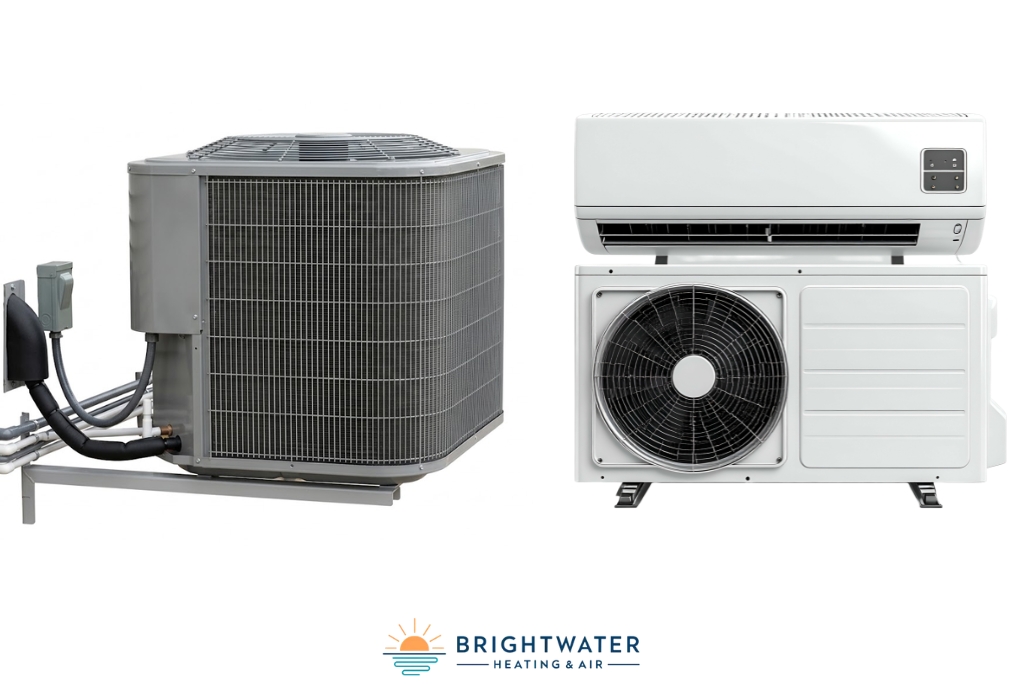
This page compares packaged HVAC units and ducted split systems for homes in Huntington Beach and coastal Orange County. It explains how to identify which system a home already has, covers coastal salt-air exposure, lifespan, replacement logistics including roof access, and whether conversion is worthwhile. Ductless mini-splits are a third option covered in a separate guide. Written by Brightwater Heating & Air, a licensed California HVAC contractor, CSLB #1004454.
Package unit vs. split system comes down to one outdoor cabinet or an outdoor unit paired with an indoor cabinet. The better fit usually depends on the system your home was built around.
Orange County homeowners often face this question when an aging rooftop or ground-level system needs replacement. Equipment location, duct paths, electrical connections, and service access can shape the project as much as efficiency. Near the coast, salt air can speed corrosion and affect equipment life.
If your home has no usable ducts, ductless mini-splits are a different decision path. That comparison lives in a separate guide, and it is linked in the decision section below.
What Sets a Package Unit Apart From a Split System
A package unit puts the compressor, condenser, evaporator coil, blower, and heating components all in one outdoor cabinet. That cabinet typically sits on a flat or low-slope roof or a ground pad. Ducts connect directly to it from above or below.
A ducted split system divides the work. The condenser and compressor live outside, usually on a concrete pad next to the house. The evaporator coil and blower live inside, in an attic, closet, garage, or crawlspace. Refrigerant lines run between the two units.
Brightwater Heating & Air sees both configurations regularly across Orange County. The difference is physical: where the equipment lives, not how well it performs. Either system can provide cooling only, gas heat plus cooling, or heat-pump operation depending on the model.
Package units are common in homes built around rooftop duct connections, especially in coastal neighborhoods where flat or low-slope roofs are standard. Split systems are typical in homes with attic or closet space for an indoor air handler or furnace.
Commercial property managers with package unit questions can review our commercial package unit service page.
How to Tell Which System You Have
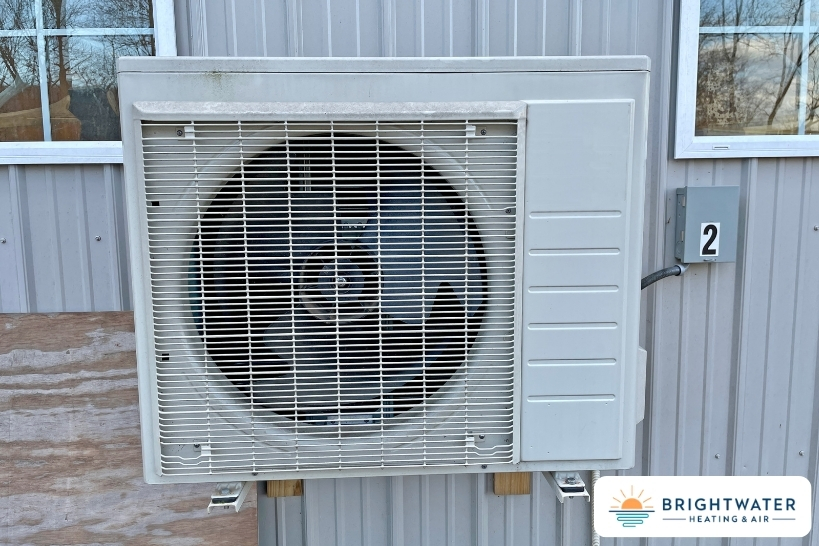
Start outside. Look for a large outdoor cabinet on your roof or a ground pad that connects directly to ducts entering the house. If that cabinet is the only piece of outdoor HVAC equipment, you likely have a package unit.
If you have a smaller outdoor condenser alongside a separate indoor unit in your attic, garage, closet, or crawlspace, you have a split system.
Four checks that work without removing any panels or climbing on the roof:
| What to Check | What to Look For |
|---|---|
| Look for rooftop equipment | A large cabinet on the roof with ducts connecting below it points to a package unit. A smaller outdoor condenser sitting beside the house is part of a split system. |
| Find the indoor unit | A furnace or air handler inside the home in an attic, closet, garage, or crawlspace means you have a split system. No indoor unit means you likely have a package unit. |
| Count the model plates | A package unit has one label on the outdoor cabinet. A split system has separate labels on the outdoor condenser and the indoor unit. |
| Check the data plate location | On a package unit, the label is usually on or near the service-panel door of the outdoor cabinet. Photograph any label you can safely reach from the ground and share it with your contractor. |
Do not remove panels, reach into equipment, or climb onto a roof to check. A photograph of the accessible model label gives your HVAC contractor everything needed to identify the system and quote a replacement.
A ductless mini-split is also technically a split system, but it is a separate no-ducts option and not the comparison here.
Package Unit vs. Split System: Side-by-Side Comparison
Neither configuration wins every category. Your home’s layout, duct path, equipment access, and replacement scope matter as much as the efficiency rating.
| Factor | Packaged HVAC Unit | Ducted Split System |
|---|---|---|
| Where equipment lives | One outdoor cabinet (roof or pad) | Outdoor condenser plus indoor air handler or furnace |
| Indoor mechanical space | Little or none needed | Requires attic, closet, garage, or crawlspace space |
| Duct connection point | Roof curb or exterior cabinet opening | Indoor plenum; supply and return ducts run inside |
| Typical efficiency range (SEER2) | 14.3 to ~16 SEER2 (DOE 2023 minimum applies) | 14.3 to 22+ SEER2; wider high-efficiency range |
| Coastal lifespan | 15-20 yrs under normal conditions; coastal wear accelerates this | 15-20 yrs; blower and coil sheltered from salt air |
| Indoor noise level | Blower and compressor outdoors; curb vibration and duct rumble possible | Indoor blower location affects noise; compressor stays outside |
| Service access | Single outdoor cabinet; roof access may be needed | Separate indoor and outdoor access points |
| Salt-air and weather exposure | All major components fully exposed outdoors | Blower and evaporator coil sheltered indoors |
| Replacement complexity | Crane or lift may be needed; curb and duct transitions required | Line-set, condensate, indoor-unit placement required |
| Best fit | Homes built around rooftop or pad-mounted duct connections | Homes with indoor mechanical space and more efficiency options |
A package unit can simplify space planning. Its major components stay outside, which is practical for homes designed around rooftop equipment. Like-for-like replacement avoids the indoor remodeling a conversion would require.
Split systems generally offer more efficiency and comfort-feature choices. That said, the nameplate rating is only part of the result. Proper sizing, matched components, duct performance, and installation quality determine real-world comfort and energy use. Start any replacement with an ACCA Manual J load calculation.
The Department of Energy sets a minimum of 14.3 SEER2 for packaged equipment under 2023 federal standards. Verify current ratings with California Energy Commission listings and manufacturer documentation before selecting equipment.
Why Package Units Are Common in Some Orange County Homes
Older housing tracts, flat-roof designs, and limited indoor space explain most of Orange County’s package-unit installations. Low-slope or flat roofs with no usable attic, slab-on-grade foundations without a crawlspace, and tight utility closets can leave no practical room for an indoor air handler.
This pattern shows up in parts of Huntington Beach, Seal Beach, Sunset Beach, Newport Beach, and Costa Mesa, especially in neighborhoods built around rooftop duct connections. It also appears in homes where a room addition or floor-plan change left the mechanical area too cramped for a split-system air handler.
Three housing characteristics drive package-unit prevalence in coastal Orange County:
| Housing Characteristic | Why It Favors a Package Unit |
|---|---|
| Flat or low-slope roofs | Older tracts along the coast often have minimal roof pitch, no accessible attic space, and duct systems designed to run through the roofline. A rooftop package unit is the natural fit. |
| Slab-on-grade construction | Homes without basements or crawlspaces have nowhere below grade to route refrigerant lines to an indoor unit. The package unit keeps everything outside. |
| Space-constrained additions | Older homes that expanded over the decades sometimes have closets, hallways, and utility areas too tight for a modern air handler. Staying with a package unit avoids major interior work. |
For homes in these situations, the package unit was the practical answer when the house was built. For a like-for-like replacement, it may still be the practical answer today.
Salt Air, Sun, and the Roof: What Coastal Exposure Does to a Package Unit
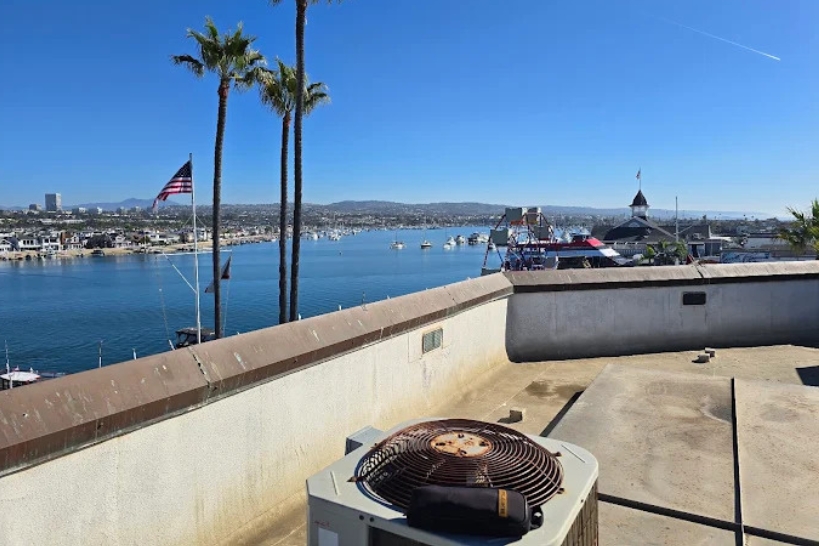
A split system shelters its blower and evaporator coil indoors. A package unit keeps every major component outside: cabinet panels, coils, fasteners, electrical connections, blower, and condensate drainage.
Near the coast, that exposure matters. Heresite Protective Coatings has documented that salt film and marine moisture form an electrolyte that accelerates corrosion on exposed metal surfaces. Here is how that works component by component:
| Component | How Coastal Exposure Affects It |
|---|---|
| Cabinet and housing | Salt-laden marine air oxidizes the paint and outer shell faster than in inland locations. Faded or flaking paint is often the first visible sign. |
| Coils | Aluminum fins corrode in salt air. Coil coatings such as ElectroFin or Blygold extend coil life, but the coating must cover edges completely and be properly maintained. Ask what coil protection is included before accepting a vague description of coastal treatment. |
| Fasteners | Standard steel hardware rusts quickly in coastal conditions, often within one or two seasons. Stainless or galvanized fasteners hold up significantly better. |
| Electrical connections | Salt mist infiltrates conduit and terminals and can cause arcing and contact failures over time. This is one of the less obvious but more consequential failure points in rooftop equipment. |
| Blower | The package unit’s blower sits fully exposed outdoors. A split-system blower stays sheltered inside the home, away from marine air. |
| Condensate drainage | Rooftop drainage issues such as ponding water near the curb or damaged flashing increase moisture exposure and can accelerate corrosion from below. |
The Department of Energy rates standard packaged equipment for a normal service life of 15 to 20 years (DOE, 2023). Coastal conditions accelerate wear on all exposed components. The gap between normal and coastal-life expectancy depends on the equipment’s coatings, installation quality, and maintenance history.
For Huntington Beach, Seal Beach, and other beachside properties, Brightwater recommends a professional inspection every six months, plus an annual coil rinse where the manufacturer approves it and safe access exists. Learn more about protecting your system from salt air and corrosion.
Can You Switch From a Package Unit to a Split System?
Yes, but it is rarely cheap or simple. Unless a major remodel is already underway, the cost and disruption usually outweigh the benefits.
A package-to-split conversion goes beyond swapping equipment. The project typically requires:
- Creating space for an indoor air handler or furnace in an attic, closet, garage, or crawlspace where none currently exists.
- Running new refrigerant lines, wiring, and condensate drainage through the home.
- Closing the existing roof opening, curb, and flashing.
- Finding a code-compliant outdoor location for the new condenser and a clear electrical path.
- Repeating the ACCA Manual J load calculation if windows, insulation, additions, or duct conditions have changed since the original installation.
When the existing roof curb, ducts, and electrical setup are sound, a like-for-like package-unit replacement is usually the simpler call. A split-system conversion makes more sense when the home is being remodeled, indoor space is opening up anyway, or the current roof and duct setup would need major repairs regardless.
An honest take: if conversion is not part of a larger project, the total cost and disruption often outweigh the gains. For a full picture of what drives replacement costs in this area, see our guide to HVAC installation cost factors in Huntington Beach.
What Rooftop Package Unit Replacement Involves
A like-for-like rooftop replacement is simpler than a conversion, but it still requires careful planning. Account for these four logistics before any work is scheduled:
| Logistics to Plan For | What to Confirm |
|---|---|
| Roof access and equipment staging | The installer must verify a safe route to the roof and enough space to stage the new unit before removing the old one. |
| Crane or lift | Whether one is needed depends on unit weight, roof height, nearby power lines, and site access. Confirm the lifting plan before scheduling. |
| Curb and duct connections | The new unit may not match the existing curb dimensions. A curb adapter or duct transition may be required for a clean connection. |
| Flashing and roof repair | Removing and reinstalling a rooftop unit can disturb the roof surface around the curb. Clarify in writing who carries responsibility for any flashing work or roof repairs before the project starts. |
Ask for a written estimate that lists crane or lift work, curb adapters, roof repair, electrical work, duct modifications or testing, permits, and old-unit disposal as separate line items. That makes it easier to compare bids on equal terms.
Permits, inspections, California Title 24 energy compliance, and HERS duct-leakage testing may apply depending on project scope. Check current Huntington Beach Building Division requirements before work begins.
Ready to schedule a rooftop replacement evaluation?
Call (714) 316-3755Which System Suits Your Home?
Start with what the home already has, then check whether a change is practical. Use this decision path:
| Decision Path | When It Fits |
|---|---|
| Choose a like-for-like package-unit replacement if | Your home already has a roof- or pad-mounted package unit, the curb and ducts connect cleanly, and there is no practical indoor space for an air handler. This is usually the most straightforward path. |
| Lean toward a ducted split system if | You have a usable attic, closet, garage, or crawlspace space and want access to a wider range of efficiency and comfort-feature options. |
| Pause and compare total project scope if | Conversion requires major roof work, new ductwork, extensive refrigerant-line routing, or electrical upgrades, especially if a remodel is not already planned. |
| Consider a heat-pump version of either system if | You are evaluating all-electric heating. Check equipment availability, code requirements, and utility-incentive eligibility. For questions about heating options, visit our heating services page. |
| Choose neither ducted option if | Your home has no usable ducts or indoor mechanical space. That is the ductless mini-split path. Our guide to coastal mini-split myths covers that comparison. |
The distinction matters: mini-split versus central AC answers the no-ducts question. Package unit vs. split system answers where a ducted system’s equipment lives.
Before deciding, have a professional assess Manual J sizing, duct condition, roof or attic access, coastal corrosion exposure, and permit requirements. Schedule an evaluation with Brightwater Heating & Air.
Request a Free EstimateFrequently Asked Questions
How do I know if I have a package unit or a split system?
Look outside first. A large single cabinet on the roof or a ground pad with ducts entering the same unit points to a package unit. An outdoor condenser paired with a separate indoor furnace or air handler is a split system. Check the model data plates from a safe location, but do not remove panels or climb on the roof. Photograph any label you can safely reach and share it with your contractor.
Do package units cost less than split systems?
Not necessarily. Equipment price alone does not tell the full story. Compare installation labor, crane or lift fees, curb-adapter needs, duct and electrical changes, permits, efficiency ratings, and expected maintenance costs before making a decision. The total project cost can look very different from the equipment sticker price.
How long does a package unit last in a coastal climate?
The Department of Energy rates standard packaged equipment for 15 to 20 years under normal operating conditions (DOE, 2023). Coastal salt air, marine moisture, and sun accelerate wear on all exposed components. Proper coil coatings, stainless or galvanized fasteners, regular coil rinses where manufacturer-approved, and twice-yearly professional inspections can slow the decline.
Are package units louder inside the house?
The blower and compressor sit outdoors in a package unit, which keeps most noise outside. Rooftop vibration and duct rumble can travel indoors, though. Proper curb isolation, flexible duct connectors, secure duct supports, and well-designed duct transitions reduce noticeable noise inside the home.
Can a package unit both heat and cool?
Yes. Most package units come in three configurations: air conditioning with electric heat strips, gas/electric units with a built-in gas furnace section, and heat pumps that provide both heating and cooling from one cabinet. The right option depends on your existing fuel connections, local code, and heating needs.
Do you need a crane to replace a rooftop unit?
Often, but not always. Whether a crane or mechanical lift is needed depends on unit weight, roof height, available access routes, proximity to power lines, and space for safe staging. Confirm the lifting plan, permit requirements, and site-access logistics before any rooftop work is scheduled.
Not Sure What You Have? We Can Help.
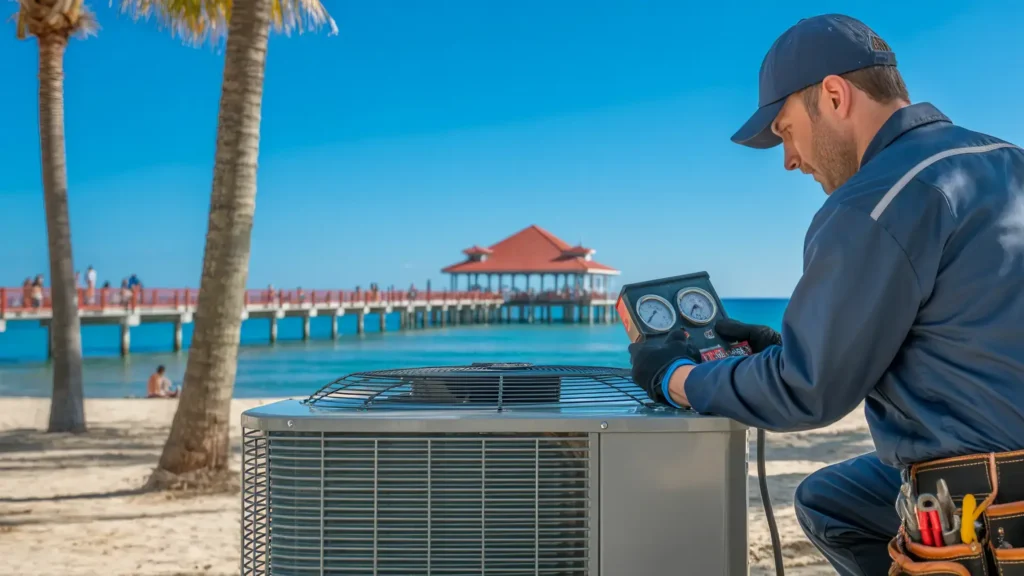
If you are not sure whether your home has a package unit or a split system, Brightwater Heating & Air can tell you. We serve Huntington Beach, Seal Beach, Newport Beach, Sunset Beach, Costa Mesa, and communities throughout Orange County.
Brightwater is licensed in California, CSLB #1004454. A Maintenance Membership can help catch wear before it becomes a larger repair if you are keeping your current system.
Call us at (714) 316-3755 or use the contact form to schedule an evaluation. We will identify your system, check for coastal corrosion, and walk you through your options.
Request a Free Estimate Call (714) 316-3755